
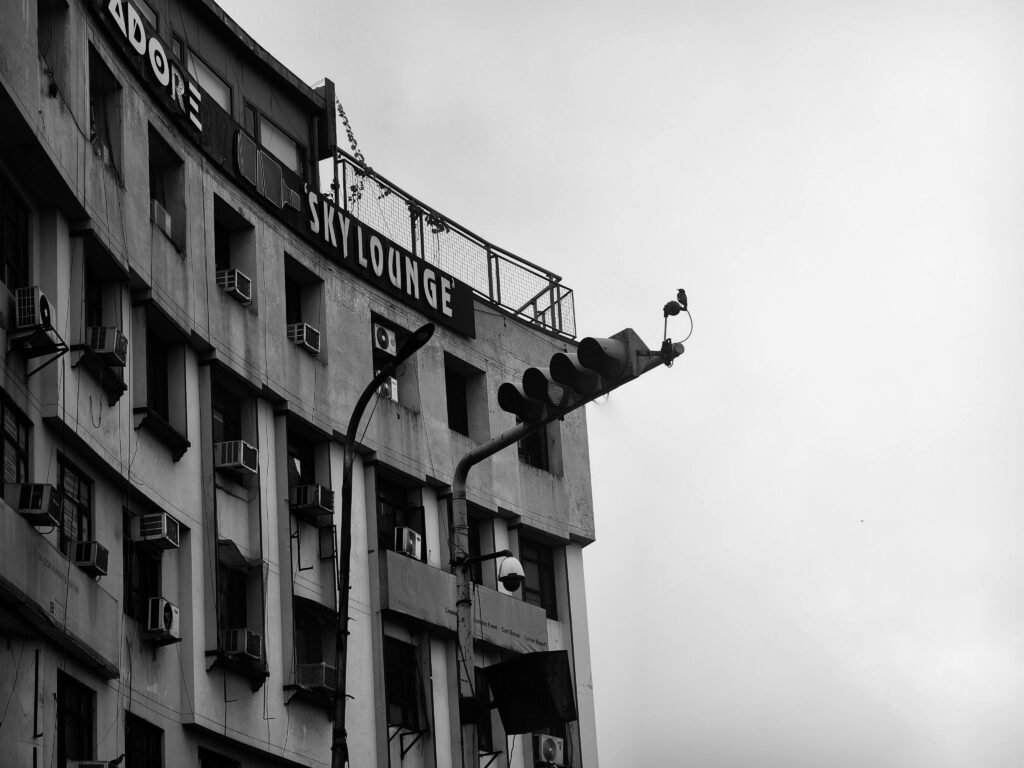
Cities are living organisms—ever-changing, ever-growing, and rarely pausing long enough for anyone to truly understand their rhythm. They breathe through the hum of traffic, blink through the glow of streetlights, and speak through buildings that silently hold the weight of countless untold stories. In the image above, a monochrome slice of city life captures this idea with striking clarity. A worn-down building, a silent traffic light, and a lone bird perched above the bustling world below come together to form a portrait of urban existence that feels both familiar and hauntingly poetic.
This single frame opens a window into the unseen parts of city life—the in-between spaces where chaos meets calm, where routine meets reflection. It invites us to look deeper into the architectural, social, and emotional layers of modern urban landscapes.
In this article, we explore the message behind the image, the emotions it evokes, the symbolic elements within the scene, and what it tells us about the modern metropolitan experience. Think of this article as a guided walk through an urban moment frozen in time.
The Stark Beauty of Urban Decay
One of the first things that strikes the viewer is the weathered façade of the building. Its surface—the chipped paint, aging walls, and protruding air-conditioning units—reflects a story of time and use. This is not the kind of polished, glamorous architecture featured in travel brochures. Instead, it is raw, unfiltered, and honest.
Urban decay, in many ways, is a paradox. While it shows the slow deterioration of physical space, it also showcases the resilience of the structures—and the people—who inhabit them. These buildings survive heat, rain, pollution, and the everyday wear and tear of city life. They don’t try to hide their age. They wear it.
From an architectural perspective, such buildings mark a transitional era—old enough to show wear yet still functional enough to house businesses, apartments, small shops, and daily routines. They are utilitarian more than aesthetic, but in their imperfection lies a different kind of beauty.
This image captures that perfectly: a building past its prime, yet alive with traces of human existence. Each air-conditioner tells a story of a room; each window tells a story of a life inside. Together, they create a mosaic of urban living that often goes unnoticed.
The Symbolism of the “SKY LOUNGE” Sign
Interesting contradictions appear within the image, and perhaps the most symbolic is the “SKY LOUNGE” sign perched on the rooftop. The phrase evokes luxury, comfort, and an elevated lifestyle—things that seem at odds with the aging structure that supports it.
And yet, this contrast mirrors what life in densely populated cities often looks like: fragments of aspiration amid the struggles of everyday life. The sign becomes a metaphor for ambition—an outward projection of something better, higher, more refined than the visible surroundings.
This juxtaposition raises thoughtful questions:
- Do cities constantly mask their imperfections with dreams of something grander?
- Is urban life always caught between what it is and what it wants to be?
The image doesn’t answer these questions outright. Instead, it invites viewers to reflect on them personally. For many people, especially those living in large cities, this contradiction feels relatable. Dreams rise from the most unexpected corners—and sometimes from the oldest rooftops.
The Silent Traffic Light and the Pause in Motion
On the right side of the frame, a traffic light juts into an empty sky. There are no cars beneath it, no noise, no motion. In a city, a traffic light is usually a command center of movement—stopping, starting, guiding, and signaling.
But here, in this photograph, it stands as a quiet, almost lonely figure.
The silence of the traffic light carries emotional weight. It represents a momentary pause in the constant movement of urban life. It reminds us that even in the busiest environments, there are still moments—small but meaningful—when everything stands still.
In many ways, this stillness reflects the experience of city dwellers who occasionally find themselves pausing amid the rush, trying to catch their breath in the middle of an otherwise relentless routine. The image captures that pause—a brief intermission in the drama of everyday life.
The Lone Bird: A Symbol of Perspective
Perhaps the most poetic part of the image is the lone bird perched calmly atop the traffic light. Its presence seems insignificant at first glance, but symbolically, it adds depth and emotion.
Birds have always represented freedom, clarity, and perspective. In a photograph dominated by concrete, metal, and signs of human construction, the bird serves as a reminder of nature’s quiet resilience. It exists above the hustle, unbothered by the cracks in the walls, the noise of the streets below, or the ambitions plastered across rooftops.
In the chaos of urban life, the bird symbolizes:
- Stillness in motion
- Nature within the urban jungle
- A perspective beyond the human eye
Its small silhouette against the vast empty sky suggests that even within crowded cities, life finds a way to stay simple, calm, and grounded.
Monochrome Photography and the Mood It Creates
The choice of black and white in this image profoundly shapes its emotional impact. Removing color forces the eyes to focus on shapes, shadows, and contrasts. It strips the image down to its essence: structure, mood, and story.
Monochrome photography often evokes nostalgia, introspection, and seriousness—and this image is no exception. The grayscale tones highlight the building’s age, the somber sky, and the overall quietness of the scene. The absence of color transforms a regular urban snapshot into a contemplative moment.
It also subtly emphasizes the theme of duality:
- Light vs. shadow
- Calm vs. chaos
- Decay vs. aspiration
- Nature vs. city
All of these contrasts live harmoniously within the frame, thanks to the timeless nature of monochrome photography.
A Glimpse Into Urban Life and Human Stories
While the image contains no visible people, it is full of human presence. Every window tells a story. Every AC unit suggests activity. Every sign hints at businesses that depend on the city’s constant movement.
Urban landscapes like this one remind us that cities are shaped by the people who live within them—even if they remain unseen. Behind each shuttered window is a morning routine, an evening meal, or a late-night conversation. Behind each wall is laughter, stress, ambition, rest, and survival.
This photo reveals the human condition indirectly:
- The perseverance found in aging structures
- The dreams captured in rooftop signs
- The unavoidable routines symbolized by traffic lights
- The quiet resistance embodied by the lone bird
In all these ways, the image is deeply human, even without a single person in sight.
What This Image Teaches Us About Modern Cities
Modern urban environments are complex spaces filled with beauty, contradiction, and constant transformation. This image encapsulates several key truths about city life:
1. Cities Are a Blend of Old and New
The weathered building and the hopeful SKY LOUNGE sign show how cities constantly balance between what they have been and what they want to become.
2. Stillness Exists Even in Busy Places
The quiet traffic light reminds us that moments of pause—even in chaotic environments—are both real and necessary.
3. Nature Finds Its Place Everywhere
The bird perched above the traffic signal symbolizes resilience and perspective, even within concrete surroundings.
4. Imperfection Has Its Own Beauty
Cities don’t need polished aesthetics to tell powerful stories. Sometimes, the cracks, stains, and shadows reveal the most authentic layers.
5. Urban Life Is More Human Than We Think
Even in an image devoid of people, traces of human existence dominate every inch of the frame.
Conclusion: A City’s Soul in a Single Frame
This photograph is more than a depiction of a building, a traffic light, or a solitary bird. It is a portrait of urban life—its contradictions, its beauty, its dreams, and its quiet, often unnoticed moments of stillness.
Cities are built from concrete and steel, but they are defined by the stories, emotions, and experiences of the people who inhabit them. This image captures the soul of that human-made world, reminding us that within every crack and every shadow, there is meaning waiting to be discovered.
In an era where cities grow faster than ever, where noise becomes a constant companion and movement rarely stops, images like this offer a rare moment of reflection. They invite us to pause, observe, and appreciate the unnoticed poetry of urban existence.
And sometimes, that’s exactly what we need—a moment to look up, see the bird on the traffic light, and remember that even in the busiest corners of the modern world, silence still exists.