
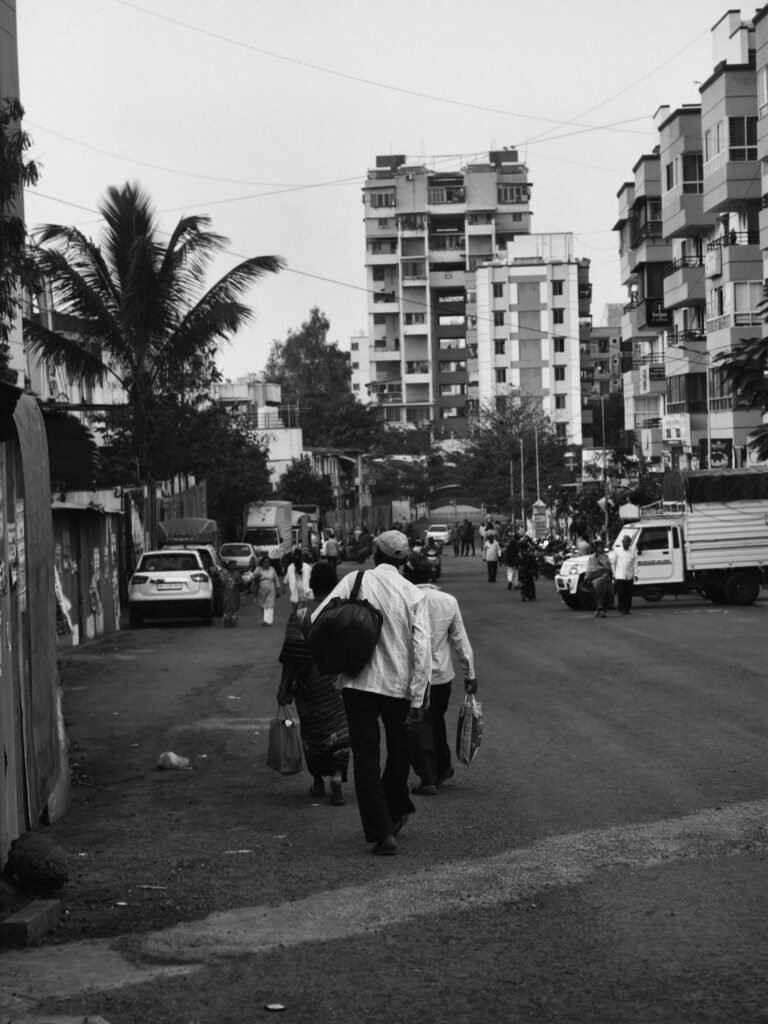
Urban India is a world full of contrasts — rising skyscrapers next to narrow streets, bustling crowds moving beside calm corners, and people from every background walking the same roads yet living completely different realities. The black-and-white photograph above captures one such moment. At first glance, it seems like an ordinary scene: people walking down a city street, vehicles passing by, buildings lining the road.
But when you look deeper, this image tells a story — a story of migration, survival, resilience, and the constant motion that defines urban life. It freezes a moment that millions of people live every single day, yet seldom notice.
In this article, we explore the emotional, social, and symbolic meaning of this photograph. Through observation and storytelling, we dive into what urban life in India truly looks like — beyond modern buildings and busy traffic.
A Moment of Movement and Meaning
The photograph is filled with movement. People are walking forward with bags in their hands, vehicles are parked or passing by, and in the distance, more pedestrians fill the street. The towering buildings in the background form a striking contrast to the people walking calmly in the foreground.
Even in black and white, the scene feels alive.
The absence of color actually adds depth to the image — it removes distraction and directs attention to human motion, small details, and raw expressions of everyday life.
The Everyday Journey of Urban Workers
The people in the foreground appear to be walking with purpose. Bags in hands, belongings on shoulders — these are symbols of daily routines. Whether they are heading home, leaving work, going to the market, or simply moving from one responsibility to another, the image beautifully captures the rhythm of city life.
In Indian cities, walking is more than just a physical act. It is a journey shaped by:
- long commutes
- economic challenges
- unpredictable work schedules
- the pursuit of stability
- unspoken dreams and responsibilities
This photograph reminds us of the countless individuals who navigate cities with strength, carrying the weight of their lives in a bag, in their steps, and in their determination.
Urban India: A Landscape of Contrast
One of the most striking elements in this image is the contrast between the tall apartment buildings and the humble street life below. This contrast reflects the reality of Indian cities:
- Wealth and struggle exist side by side.
- Modern infrastructure grows around traditional lifestyles.
- People from different economic backgrounds walk the same road.
The high-rise apartments symbolize modern progress, ambition, and urban expansion. Meanwhile, the pedestrians represent the heartbeat of the city — the people who keep it alive every single day.
It is a reminder that behind every building, shop, or road, there are human stories holding everything together.
Migration: The Footsteps That Build Cities
The image also captures a deeper story — the silent journey of migrants.
For decades, millions of people from villages and small towns have moved to cities in search of:
- work
- education
- stability
- opportunity
- a better life for their families
Many of them take long walks like the one shown in this photograph. These walks become part of their identity — steps that shape their future and build the city around them.
Cities grow because people move. And people move because hope pushes them forward.
The photograph is a tribute to these journeys.
The Strength Hidden in Ordinary Moments
Urban life is often romanticized through flashy lights, modern architecture, and high-speed lifestyles. But the real strength of a city lies in its ordinary moments — people walking, working, and living with resilience.
This simple scene holds powerful emotions:
1. Hard Work
The bags people carry represent the efforts they put into their daily lives — groceries, tools, supplies, personal belongings.
2. Routine
Whether morning or evening, the act of walking down a city road is part of the rhythm of life.
3. Determination
Despite challenges, people continue moving forward — always.
4. Community
Though everyone walks separately, they share a common path. This represents the unspoken unity of urban living.
The Power of Black-and-White Photography
Choosing black and white for this image enhances its emotional impact. Without color, we notice:
- textures of the road
- patterns of buildings
- the sharp contrast between light and shadow
- the focus on human presence
- the mood of the scene
Black-and-white imagery often symbolizes reality, honesty, and depth. It strips the scene down to its truth and reminds us of the timeless nature of urban struggle.
This photograph feels like a documentary frame — an unfiltered look at life as it is.
The City as a Living Organism
Every city is alive. It breathes through:
- its people
- its streets
- its traffic
- its buildings
- its constant movement
This image captures the city as an ecosystem — vehicles aligning on the sides, pedestrians filling the centre, buildings forming the skyline, and trees adding a touch of nature. Everything exists together in a delicate balance.
And at the heart of this ecosystem stands the ordinary person.
The Silent Stories of the Street
If we could pause the scene and listen, the street would speak.
It would tell stories of:
- people walking miles every day
- workers starting their shifts before sunrise
- families balancing dreams with responsibilities
- street vendors trying to earn a living
- migrants building their future one step at a time
Every person in the frame carries a unique story. And every story adds to the identity of the city.
The Connection Between People and Place
Urban life shapes people — and people shape urban life.
The individuals walking in the foreground show an intimate connection with the street. They know every turn, every shop, every corner. Their footsteps create familiarity, routine, and eventually, belonging.
A city becomes home not because of buildings, but because of the journeys people take within it.
The Challenges of Daily Urban Life
Behind the calm look of this photograph lies the reality of urban hardships:
- long working hours
- rising expenses
- dense traffic
- crowded streets
- limited space
- constant noise and movement
Yet, people continue to adapt. The photograph shows resilience not in dramatic moments, but in quiet, everyday actions — the simple act of walking forward.
Urban Streets as Mirrors of Society
This street reflects more than movement — it reflects society itself.
- Social inequality
- Economic diversity
- Cultural coexistence
- Community connection
- Unspoken struggles
- Hope for a better future
Every building, vehicle, and pedestrian tells a part of the larger story of modern India.
A Timeless Scene of Human Strength
Though this image is rooted in the present, it feels timeless. People have walked streets like this for generations — carrying bags, responsibilities, hopes, and dreams. Cities have changed, buildings have grown taller, and technology has evolved, but human determination remains the same.
That is what gives the photograph its emotional weight.
Conclusion: A Walk Through Reality
This photograph is much more than a street scene.
It is a reflection of:
- urban struggle
- human resilience
- social complexity
- coexistence of progress and hardship
- the quiet strength found in everyday life
Through a simple walk down the road, the image captures a powerful piece of India’s urban story. It reminds us that behind the skyscrapers and city lights, there are people who move the world forward — one step at a time.
Sometimes the most ordinary moments reveal the most extraordinary truths.