
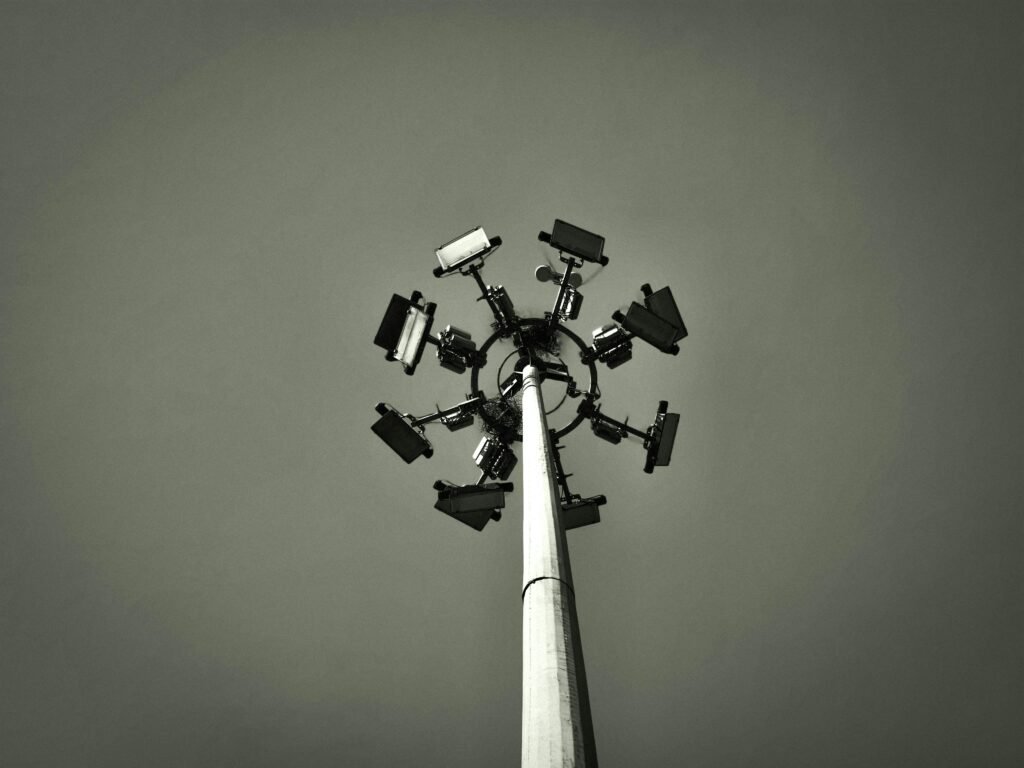
In today’s rapidly evolving urban landscape, surveillance has silently transformed from a simple precaution to an essential pillar of modern city infrastructure. The image above captures this transformation in a powerful, almost poetic way—a towering surveillance pole standing tall against the sky, equipped with an array of cameras pointing in every direction. It represents more than just security equipment; it symbolizes the shift toward smart cities, real-time monitoring, and data-driven governance. As technology continues to shape public safety, these tall surveillance structures are becoming familiar elements in our streets, highways, and public spaces.
This article explores the meaning, purpose, and impact of such surveillance towers, diving deep into their role in enhancing urban security, traffic control, and emergency response systems. We will also discuss privacy concerns, the future of surveillance technology, and how societies can balance protection with personal freedom.
The Evolution of Urban Surveillance
Surveillance is not new. For centuries, communities relied on watchtowers, guards, and patrol units to monitor activity and maintain order. However, the sophistication of today’s technology has completely changed the scale and efficiency of observation. High-mast surveillance systems—like the one seen in the image—are the modern equivalent of watchtowers, but equipped with advanced tools such as:
- High-resolution cameras
- Motion sensors
- Facial recognition systems (in some regions)
- Night-vision and infrared lenses
- Automatic Number Plate Recognition (ANPR) systems
- Environmental sensors
Cities across the world are adopting these solutions as part of their entrance into the “smart era”—a time where data collection is crucial for decision-making and rapid action.
Why Surveillance Towers Are Becoming Common in Cities
The growing presence of these tall surveillance installations raises a simple question: why are they everywhere now?
1. Crime Prevention and Law Enforcement
Urban crime rates can fluctuate dramatically. Cameras placed high above ground provide a 360-degree view, allowing authorities to monitor suspicious activity in real time. These systems often deter criminal behavior simply through their presence.
2. Traffic Monitoring and Road Safety
Most major cities struggle with road congestion. Surveillance towers help:
- Analyze traffic flow
- Monitor accident-prone zones
- Improve signal timing using real-time data
- Detect violations like speeding or illegal turns
Many traffic management systems rely heavily on visuals captured by such towers.
3. Emergency Response
In moments of crisis—fires, natural disasters, or violent incidents—real-time footage becomes essential. High-masts with multi-angle cameras can assist first responders by providing instant situational awareness, which leads to faster, more accurate decisions.
4. Urban Planning and Smart Governance
City planners use collected data to improve infrastructure and policies. Whether it’s adjusting street lighting or expanding road lanes, surveillance footage provides insights that are otherwise impossible to gather at such scale.
A Symbol of Power, Protection, and Accountability
From a visual perspective, the image conveys something deeper. The upward angle and monochromatic tone create a sense of authority. The cameras resemble a mechanical flower blooming toward the sky—each “petal” serving as an eye watching over the city.
It raises an important duality:
- Protection: Surveillance ensures the safety of residents, helps fight crime, and keeps cities running efficiently.
- Power: At the same time, it symbolizes how much control institutions have over public spaces.
This visual tension mirrors a global debate—how much surveillance is too much?
The Privacy Debate: Are We Being Watched Too Closely?
While there are undeniable benefits, high-mast surveillance systems raise deep questions about civil liberties and personal privacy. Critics argue that:
- Excessive monitoring may create a sense of constant observation.
- Data collected may be misused if not regulated properly.
- Facial recognition technology can lead to wrongful identification.
- Over-surveillance can reduce personal freedom in public spaces.
Balancing safety and privacy is one of the biggest challenges of modern governance. Many countries are now developing strict regulations ensuring that surveillance data is protected, encrypted, and used responsibly.
Technology Behind the Tower: More Than Just Cameras
These high-rise surveillance poles are often integrated with a wide range of technologies, making them more advanced than they appear.
1. AI-Powered Video Analytics
Artificial intelligence can identify:
- Unusual activities
- Crowd density
- Abandoned objects
- Vehicle movement patterns
AI helps reduce the workload on security personnel by automatically sending alerts.
2. Cloud-Based Data Storage
Instead of relying on physical storage devices, modern cities store surveillance footage on secure cloud servers. This allows multiple departments—traffic police, emergency response, and city administration—to access live feeds simultaneously.
3. Smart Sensors and IoT Devices
Some poles include:
- Air quality sensors
- Weather detectors
- Noise-level monitors
This turns the structure into a multi-purpose smart-city tool.
How These Towers Improve Public Life
Even though the image may appear intimidating, these surveillance systems often become silent helpers in our daily routines.
1. Reducing Theft and Violence
Studies show that crime drops significantly in areas under constant surveillance. Criminals often avoid well-monitored locations.
2. Safer Roads
Automated monitoring ensures that drivers follow rules. This reduces accidents and saves lives.
3. Faster Problem-Solving
Authorities can quickly identify:
- Traffic jams
- Flooded roads
- Public disturbances
- Faulty streetlights
This helps maintain a smooth urban environment.
4. Enhancing Public Confidence
People feel safer knowing their surroundings are monitored, especially in crowded or isolated areas.
The Aesthetic Meaning of the Image
The image shows more than technology—it conveys a mood. The stark contrast, minimal sky background, and circular arrangement of cameras create a powerful artistic composition.
It subtly communicates:
- Surveillance is everywhere
- Urban life is under constant observation
- Technology is the new architecture
- Power resides in silence and height
Images like this spark conversations about the world we live in and the systems that govern us.
Smart Cities and the Future of Surveillance
As technology continues to evolve, future surveillance systems may include:
- Drone-based monitoring
- Real-time crowd management using AI
- Predictive policing tools
- Integrated smart infrastructures
- Eco-friendly solar-powered surveillance towers
Cities are moving toward environments where every connected device—from streetlights to traffic signals—contributes to real-time urban intelligence.
Ethical Use: The Key to Trust
For these technologies to be accepted widely, authorities must:
- Be transparent about what is being recorded
- Ensure strict data protection
- Allow public access to surveillance policies
- Avoid bias in AI systems
- Respect privacy zones
Responsible implementation builds trust and keeps the balance between safety and freedom intact.
Conclusion: Standing Tall in a Watchful World
The towering surveillance pole from the image is more than metal and machinery. It represents the invisible network that keeps modern cities functioning smoothly. It symbolizes vigilance, safety, technological progress, and the ever-evolving relationship between society and security.
As our cities grow larger and more complex, surveillance systems will continue to rise—literally and figuratively—shaping how we live, move, and interact in public spaces. The challenge lies not in stopping technological progress but in using it wisely, ethically, and transparently.
Urban security is not just about watching people—it’s about creating smarter, safer, and more efficient cities for everyone. And as long as we maintain accountability and protect personal freedoms, these towering “silent watchers” will remain vital pillars in shaping the cities of tomorrow.