
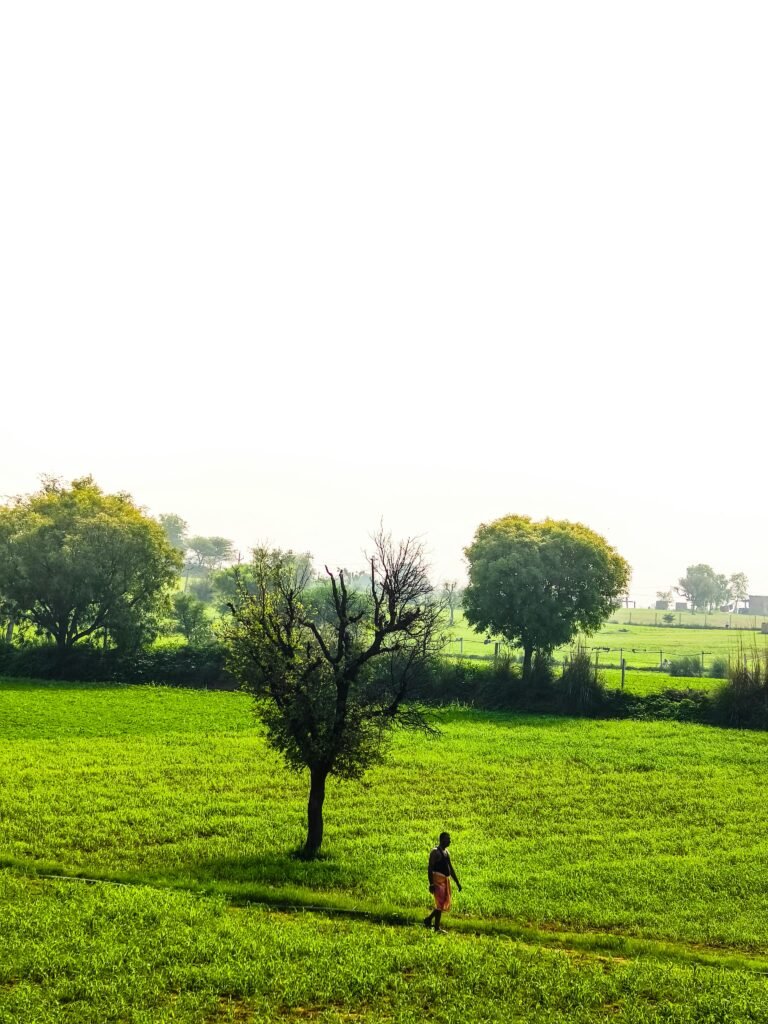
In the heart of rural India, far away from crowded cities and the digital race of modern life, lies a world built on simplicity, hard work and an unspoken bond with nature — the life of a village farmer. A single look at a lone farmer walking through a lush green field tells a story deeper than words can express. It is a story of dawns that begin before the sun rises, of seasons that decide fortunes, and of a lifestyle where the earth is not just land but a living companion.
This peaceful photograph of a farmer strolling through an emerald field captures exactly that essence. But behind this serene moment exists an entire universe of dedication, culture and emotion. Village farmer life is not merely an occupation — it is an identity, a tradition and a pillar that feeds the nation.
In this article, we explore the everyday journey of a rural farmer, the beauty and struggles of village life, the relationship with nature, and why the world must recognize the importance of their contribution.
1. The Morning Rhythm: Waking Up With Nature
A farmer’s day begins when the rest of the world is asleep. Before the first ray of sunlight paints the sky in shades of orange, the farmer is already awake, preparing for another long day. The village mornings carry a certain purity — the cool breeze, the smell of wet soil, and birds calling from the trees surrounding the fields.
For the farmer, this is the most peaceful hour. Walking through his field, as seen in the image, he observes the crops, checks the moisture in the soil, and listens to what the land quietly tells him. Unlike modern offices or factories, nature is his workplace and every day brings a new challenge.
Morning in the village is not rushed. It flows gently. Yet for farmers, every minute matters. Their relationship with time follows the sun, not the clock. This natural rhythm defines the way they work and live, creating a harmony rarely found in urban life.
2. The Bond With Soil: More Than Just Farming
Farmers do not just grow crops — they grow life. Their connection with soil is emotional and spiritual. Each seed they plant is a promise, a hope for the future. Every time rain clouds gather, it feels like a blessing. Every time drought threatens, it feels like a personal battle.
In many villages, farmers talk to their fields the way one talks to a friend. The soil is not just earth to them; it is a legacy passed through generations. They walk barefoot on the land, feeling the texture, understanding its needs, and trusting their instincts more than any written manual.
This deep relationship is beautifully captured in the photograph — a lone man walking peacefully under the shade of a tree, surrounded by green fields. The simplicity of the scene reflects a truth: farming is not defined by machines or big investments alone; it is built on love, patience and understanding.
3. The Role of Seasons: Nature’s Calendar
Unlike most professions with predictable routines, farmer life depends entirely on seasons. Summer, monsoon, winter — each one brings a different set of responsibilities.
- Monsoon is the season of sowing, the time when fields come alive with fresh green shoots.
- Winter is for tending and protecting the crops, ensuring they grow strong and healthy.
- Summer often brings the harvest, celebration and relief but also tough heat and hard labour.
This cycle forms the backbone of rural India. The farmer’s body adapts to harsh sunlight, muddy fields, cold winds and long hours. While the rest of the world often takes food for granted, farmers truly know the value of every grain.
4. Simplicity and Strength: The Lifestyle of a Village Farmer
Village life is simple but rich in values. Farmers live without excess, without the constant noise of modernity. Their homes may be modest, but their hearts are full. Their days are built around work, family, culture and community.
Meals are made from fresh produce grown in their own farms — organic without the label, pure without marketing. Festivals revolve around harvest seasons, celebrating nature and expressing gratitude.
What makes farmer life truly inspiring is their resilience. Even with uncertainties — unpredicted weather, financial limitations, market fluctuations — they continue to work with hope. They may not always express their worries, but their commitment never fades.
5. Challenges Farmers Face: The Unseen Struggles
Behind the calm beauty of the image lies a reality many people overlook. Farmers often fight silent battles:
1. Weather Uncertainty
Floods, droughts, unseasonal rains — the smallest climate change can destroy months of effort.
2. Financial Strain
Most farmers depend on loans for seeds, fertilizers or equipment. A bad season can push them into debt.
3. Market Fluctuations
They may work tirelessly, but they don’t always get fair prices for their produce.
4. Lack of Modern Tools
Many villages still lack proper irrigation, technology and storage facilities.
5. Physical Exhaustion
Long hours, harsh climate and demanding physical labour take a toll on their health.
Yet despite these challenges, farmers continue feeding millions. This strength is what makes farmer life noble and heroic.
6. The Beauty of Village Landscapes
The photograph itself tells a story of rural beauty — endless green fields, open sky, scattered trees and natural calmness. Village landscapes are healing to the eyes and soul. They reflect purity, peace and balance with nature.
The presence of a single tree standing tall in the middle of the field symbolizes resilience — just like the farmer walking beneath it. This environment shapes the mindset of village farmers: grounded, patient and connected to roots.
7. Community Bonds: Life Beyond the Fields
Village life is also defined by strong community relationships. Neighbours are more like extended family. Everyone helps during sowing, harvesting or festivals. When someone faces trouble, others step in naturally.
Farmers share tools, knowledge and experiences. They celebrate victories together and support each other through difficult seasons. This sense of unity is slowly disappearing in cities but remains strong in villages.
8. The Future of Farming: Hope and Transformation
While traditional farming remains the heart of villages, a new wave of modernization is slowly entering rural areas. Education, mobile connectivity, agricultural technology and government support are creating opportunities for the next generation.
Modern irrigation techniques, organic farming, crop diversification and direct farm-to-market systems are helping farmers earn better and reduce risk.
Still, the essence of village farmer life remains untouched — the land, the values, the culture, the dedication.
9. Why Village Farmer Life Must Be Celebrated
Farmers are the unsung heroes of our country. Every meal we eat is the result of their hard work. Without them, no city could function, and no household could survive.
The image of a farmer walking through green fields is not just a picture; it is a reminder of gratitude. It reminds us that farming is not a small job — it is the foundation of civilization.
We must appreciate and support farmers by promoting fair trade, avoiding food wastage, and valuing their efforts.
Conclusion: The Quiet Strength of a Farmer
Village farmer life is a blend of beauty, struggle, simplicity and unmatched strength. The image captures only one moment, but behind it lies a lifetime of dedication. The farmer in the field represents millions who work silently every day to keep the nation nourished.
Their lives may appear simple, but their contribution is immeasurable. They teach us patience, resilience, respect for nature and the importance of staying connected to our roots.
The village may look peaceful, but its heartbeat is strong — and that heartbeat is the farmer.