
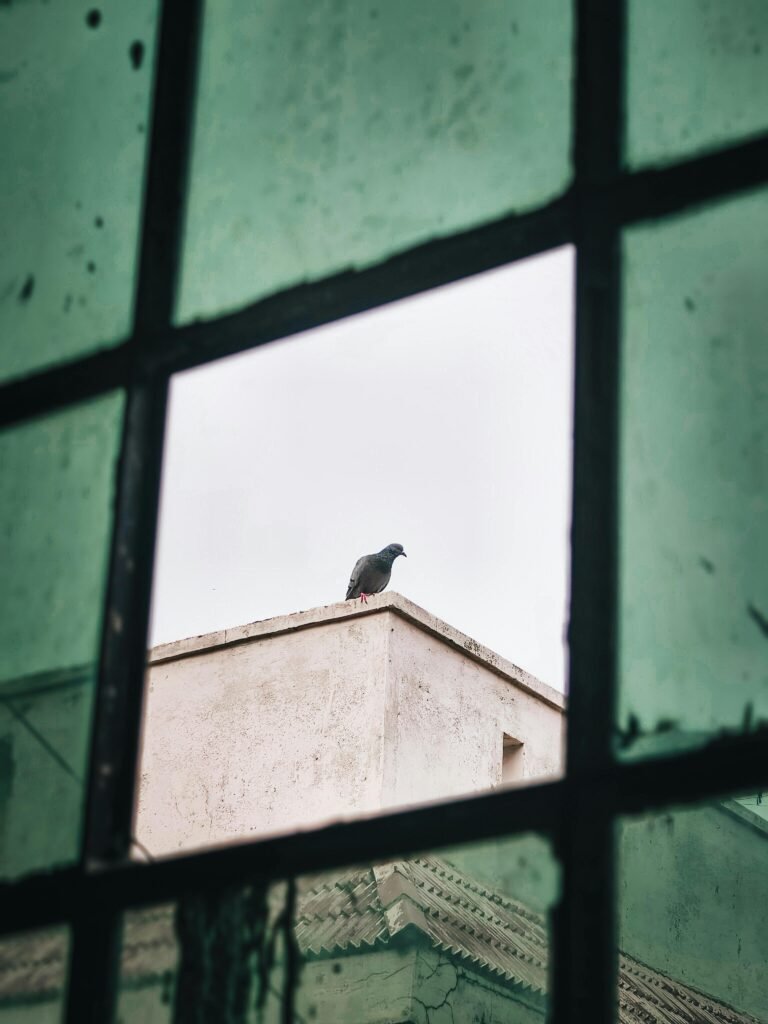
There are moments in life that speak softly yet leave a deep impression — moments where silence becomes the storyteller and stillness becomes the emotion. The image of a lone pigeon resting on the corner of an old rooftop, framed through a dusty, weathered window, is one such moment. It carries quietness, depth and meaning far beyond what meets the eye.
This single scene reflects isolation, resilience and the hidden beauty found in forgotten places. The stained green-tinted glass, the cracks in the wall, the bird standing with quiet awareness — together they create a portrait of urban solitude and nature’s gentle presence amidst decay.
In this article, we look deeper into the emotion, symbolism and story the image conveys. We uncover how a simple moment becomes poetry, how abandoned places hold life, and why solitude is not always emptiness but sometimes a form of inner peace.
1. The First Impression: A Window into Stillness
The photograph invites the viewer to look through a window — not a clean, transparent one, but one that carries stains, scratches and traces of time. This window is not just a physical frame; it is a metaphorical doorway into a moment frozen in silence.
The pigeon perched on the edge of a worn, pale building looks almost like a guardian of forgotten structures. The lighting is soft, the sky is muted and the composition draws focus to the bird’s presence. The chipped paint and cracks in the wall indicate age, wear and abandonment, yet the bird brings a quiet sense of life back to the frame.
This contrast between old and living, broken and present, creates a visual tension that makes the image powerful.
2. The Symbolism of a Single Bird
A lone pigeon often symbolizes freedom, survival, adaptability and quiet strength. These birds live in almost every corner of the world — from crowded cities to peaceful villages — and adapt to every environment.
Here, the pigeon stands calmly on the ledge as if it has accepted both the harshness and the peace of the world around it.
Symbolically, the bird represents:
- Resilience: the ability to live and thrive in neglected spaces
- Solitude: a moment away from the noise of the world
- Observation: watching life from a distance, choosing silence over chaos
- Freedom: the potential to fly anywhere, at any moment
The stillness of the pigeon against the textured backdrop tells a deeper story — sometimes the most powerful forms of strength are soft, quiet and unbothered.
3. The Forgotten Building: Beauty in Decay
The rooftop and the surrounding architecture reveal a structure that once held purpose — maybe a home, a workshop, an old institution. Today, it stands weathered by time, forgotten but not lifeless.
The cracks, the fading color, the rough texture of the plaster hold onto memories of years gone by. Though worn-out, the building has a character that new constructions often lack.
This kind of decay has aesthetic poetry. It carries emotion. It shows that time leaves marks, but marks are what create identity.
Through the window, the viewer witnesses this beauty — not polished, not perfect, but honest. And honesty has its own charm.
4. The Window: A Frame Between Two Worlds
The window itself plays a crucial role in the storytelling of this image. It separates the viewer from the outside world yet shapes how the outside world is seen.
The window symbolizes:
- Perspective: our view of life is always through some frame
- Distance: we observe, but we do not always participate
- Memory: dust and cracks represent things we overlook or forget
- Introspection: sometimes we see ourselves more clearly when we are looking outwards
The green tint of the window glass adds moodiness. It changes the tone of the photograph, making it mysterious and nostalgic. This green hue feels like a faded memory, a moment viewed through time.
5. Solitude vs. Loneliness: Understanding the Mood of the Image
At first glance, the image might appear lonely — an old rooftop, a single bird, muted colors and an empty sky. But solitude is not always loneliness; sometimes it is a peaceful pause from the world.
The pigeon does not seem sad. It seems relaxed, observant and comfortable in its stillness. The rooftop offers it a moment of quiet, away from the crowded chaos below.
This image portrays solitude as:
- reflective
- calming
- grounding
- peaceful
- meaningful
In our fast-paced lives, moments like these remind us that silence is not empty — it is full of answers we can only hear when the noise fades.
6. Urban Nature: Life in Unexpected Places
Cities grow, buildings age and humans move on, but nature always finds a way to occupy forgotten spaces. Even a crumbling rooftop becomes a resting place for a bird.
The image is a perfect reminder of how nature and urban life coexist. Despite pollution, concrete and noise, birds still fly freely. They adapt, survive and create small pockets of life in places people abandon.
This balance is delicate but beautiful. It shows how life persists — silently, gently and with incredible resilience.
7. The Emotional Depth of the Image
The photo feels cinematic. It evokes a range of emotions depending on who is looking at it:
- Some may feel nostalgia
- Some may feel peace
- Some may feel curiosity
- Some may feel the weight of time
- Some may feel the beauty of isolation
Images like this speak differently to each person. They invite interpretation rather than giving answers. The simplicity of the scene hides layers of stories.
8. The Story Behind the Moment
Photography is not just about capturing sights — it is about freezing stories. What story does this moment tell?
Maybe the bird is resting after a long flight. Maybe it comes to this rooftop every morning. Maybe the building was once alive with laughter. Maybe this window has seen years of sunshine, rain and human presence.
This moment, whether planned or spontaneous, holds significance. It reflects a world where even in decay there is life, and in silence there is meaning.
9. Aesthetic Appeal: Why the Composition Works
The composition of the photograph is visually powerful because of:
1. Framing
The window frame naturally draws attention to the bird and rooftop.
2. Color Contrast
The pale building and the grey pigeon stand out against the dark, greenish glass.
3. Symmetry and Lines
The grid-like divisions of the window add structure and balance.
4. Emotion Through Minimalism
There are few subjects in the frame, but each one carries emotion.
5. Texture and Tone
Rough walls, dusty glass and muted skies create a rustic, cinematic feel.
This careful combination gives the image its storytelling strength.
10. What This Image Teaches Us
Every photograph teaches something. This one teaches:
- Slow down and notice the small moments.
- Beauty exists even in broken or forgotten places.
- Solitude can be peaceful, not painful.
- Nature survives through every change.
- Time leaves marks, but marks create character.
The pigeon on the rooftop is a symbol of quiet endurance — a reminder to stay calm in a noisy world.
Conclusion: A Moment of Stillness Frozen in Time
The image of a bird perched on an old rooftop, framed through a dusty green window, is more than just a visual. It is an emotion captured — a story of resilience, silence, memory and quiet beauty.
It reminds us that life exists even in stillness, and that forgotten places carry stories worth noticing. The world is full of frames like this — we just need to pause long enough to see them.
Through this single moment, we understand that even the simplest scenes can hold the deepest meaning.